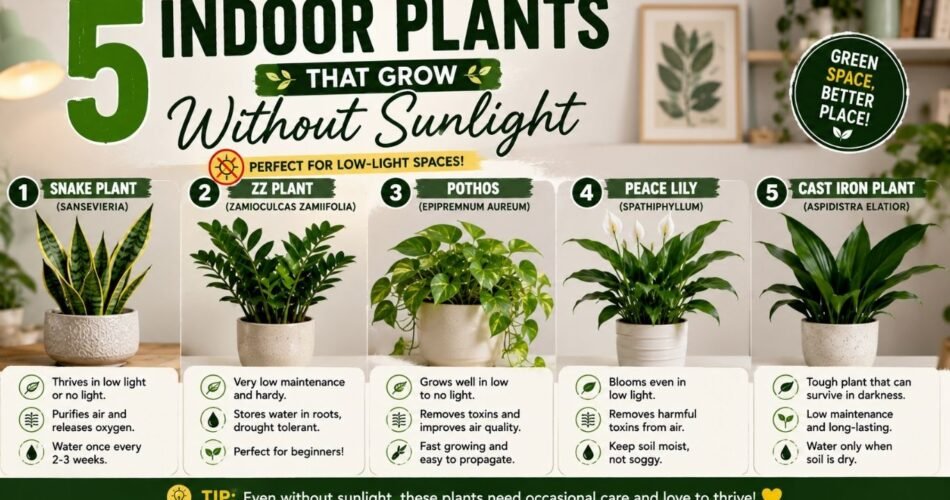
Finding the perfect indoor plant when your apartment gets barely any natural light can feel like an impossible task. Maybe you live in a basement studio, work in a windowless office, or have a bathroom tucked away in the middle of your home. Whatever your situation, the good news is that plenty of beautiful, resilient plants can genuinely thrive in low-light conditions — and they don’t require you to be a gardening expert to keep them alive.
Before we dive in, let’s clear up one important thing: no plant can survive in complete darkness. Plants need light for photosynthesis — the biological process that keeps them alive and growing. When we talk about “plants that grow without sunlight,” what we really mean are plants that can thrive in low light or indirect light — places far from windows, under artificial lighting, or in rooms with minimal natural light. These are genuinely some of the most forgiving, adaptable plants nature has to offer, and they’re perfect for beginners and busy plant parents alike.
Whether you’re decorating a dim living room, brightening up a bathroom, or adding a touch of green to your office desk, this guide covers five low-light indoor plants in detail — including care tips, common problems, pet safety, and expert advice to help them truly flourish.
Why Low-Light Indoor Plants Are Worth Growing
Most of us don’t live in sun-drenched homes with floor-to-ceiling windows. Urban apartments, north-facing rooms, basement spaces, and interior offices often receive little to no direct sunlight throughout the day. Traditional garden plants would struggle significantly in these conditions — but a select group of tropical and subtropical houseplants evolved under forest canopies where light is naturally filtered, diffused, and limited.
These plants developed the remarkable ability to make the most of whatever light is available, which is exactly why they translate so well to indoor environments with low natural light. They’re not just surviving in your dim corner — they’re designed for it.
Low-light plants offer other meaningful advantages too:
- They’re forgiving with watering — most prefer to dry out slightly between waterings
- They add genuine beauty to spaces that would otherwise feel dull and empty
- Many purify indoor air by absorbing common pollutants (if you’re curious about this benefit, check out these 6 air-purifying plants for a healthier home for a deeper look)
- They grow slowly, which means less pruning and repotting for busy people
- They’re often non-toxic or available in pet-safe varieties, making them great for households with cats and dogs
Now let’s get into the real heart of this guide — the five best indoor plants for low-light conditions, with everything you need to care for them successfully.
1. Pothos (Epipremnum aureum)
Plant Overview
If there’s one plant that truly earns the nickname “the impossible-to-kill houseplant,” it’s the pothos. Native to the Solomon Islands in the South Pacific, this trailing vine has become one of the most popular indoor plants in the world — and for excellent reasons. Its heart-shaped leaves come in a gorgeous range of varieties, including the classic golden pothos with yellow and green variegation, the striking marble queen with cream-white streaks, and the deep green neon pothos.
Pothos grows quickly, trails beautifully from shelves and hanging baskets, and has an almost supernatural ability to bounce back from neglect. I’ve personally had pothos cuttings root in a glass of water on a bathroom counter with only a small frosted window nearby — and they thrived.
Why It’s Suitable for Low-Light Conditions
Pothos evolved in the understory of tropical forests, where it grows as a ground cover beneath a dense canopy of taller trees. This means it adapted to receiving filtered, low-intensity light for most of the day. Indoors, it handles everything from medium indirect light to quite dim corners better than almost any other houseplant.
One thing to keep in mind: highly variegated varieties like marble queen need slightly more light than the all-green varieties because the white or yellow sections of the leaves contain less chlorophyll and therefore photosynthesize less efficiently. If you have a truly dark spot, stick with the golden pothos or a solid green variety.
Light Requirements
- Ideal: Medium indirect light (a few feet from a north or east-facing window)
- Tolerated: Low indirect light, fluorescent office lighting
- Avoid: Direct sunlight (scorches the leaves) and complete darkness
Watering Schedule
Water your pothos when the top 1–2 inches of soil feel dry to the touch. In most indoor environments, this works out to watering once every 1–2 weeks. During winter, you can stretch this to every 2–3 weeks, as the plant’s growth slows and it needs less moisture.
Always empty the saucer beneath the pot after watering — pothos does not like sitting in water and will develop root rot if drainage is poor.
Ideal Temperature and Humidity
- Temperature: 65–85°F (18–29°C). Avoid placing near cold drafts or heating vents.
- Humidity: Adaptable — tolerates normal household humidity (30–50%) without any trouble. Higher humidity encourages larger leaves, but it’s not essential.
Best Soil Type
A standard, well-draining potting mix works perfectly. You can mix in a small amount of perlite (about 10–20% by volume) to improve drainage and prevent soil compaction over time.
Fertilizer Needs
Feed your pothos with a balanced liquid fertilizer (10-10-10 or similar) diluted to half strength once a month during the spring and summer growing season. Stop fertilizing in fall and winter. Pothos doesn’t need heavy feeding — in fact, over-fertilizing can cause brown leaf tips and salt buildup in the soil.
Growth Rate and Mature Size
Pothos grows relatively fast under good conditions — expect several inches of new growth per month during spring and summer. Trails can reach 6–10 feet or longer indoors. You can easily control length by pruning, which also encourages bushier, fuller growth.
2. Snake Plant (Dracaena trifasciata, formerly Sansevieria)
Plant Overview
The snake plant — also called mother-in-law’s tongue — is one of those plants that looks like it belongs in an architectural magazine spread. Its stiff, upright leaves with striking green and yellow banding give it a bold, sculptural presence that adds instant sophistication to any room. Originally from West Africa, it’s been one of the most beloved houseplants globally for decades, and its reputation for nearly indestructible toughness is entirely well-deserved.
I’ve seen snake plants surviving in the corners of hotel lobbies, hospital waiting rooms, and windowless offices — places most plants would give up on within weeks. That kind of adaptability is genuinely remarkable.
Why It’s Suitable for Low-Light Conditions
Snake plants are slow metabolizers — they use a special type of photosynthesis called Crassulacean Acid Metabolism (CAM), which means they open their leaf pores at night rather than during the day to minimize water loss. This also means they’re not as dependent on constant, high-intensity light to function. They can survive in low light for extended periods, though they grow best in moderate indirect light.
Light Requirements
- Ideal: Bright to medium indirect light
- Tolerated: Low indirect light, fluorescent lighting
- Avoid: Prolonged complete darkness (they’ll survive for weeks but won’t grow)
Watering Schedule
This is where snake plants shine for forgetful plant parents. Water every 2–4 weeks in spring and summer, and only every 4–6 weeks in fall and winter. The number one killer of snake plants is overwatering — always let the soil dry out completely before watering again. When in doubt, wait another week.
Ideal Temperature and Humidity
- Temperature: 60–80°F (15–27°C). Sensitive to cold — don’t let it drop below 50°F.
- Humidity: Comfortable with low to average household humidity. Not picky at all.
Best Soil Type
Snake plants must have well-draining soil. Use a succulent or cactus potting mix, or create your own by mixing regular potting soil with 50% perlite or coarse sand. Good drainage is non-negotiable — heavy, moisture-retaining soil will cause root rot quickly.
Fertilizer Needs
Feed once or twice during spring and summer with a balanced fertilizer diluted to half strength. That’s truly all it needs. Avoid feeding in fall and winter entirely.
Growth Rate and Mature Size
Snake plants are slow growers, which is actually part of their appeal — you won’t need to repot frequently. Depending on the variety, mature plants range from 8 inches (dwarf varieties like Hahnii) to 4 feet tall. Expect modest growth of a few inches per year in low-light conditions.
3. ZZ Plant (Zamioculcas zamiifolia)
Plant Overview
The ZZ plant is a statement piece. Its thick, glossy, dark green leaves arranged in a graceful arch make it look almost too perfect to be real — many people initially think it’s artificial. Native to eastern Africa, from Kenya to South Africa, the ZZ plant evolved in environments that experience seasonal drought and low light conditions, which shaped it into one of the most drought-tolerant and low-light-tolerant houseplants available.
It’s relatively newer to the mainstream houseplant scene (popularized in the late 1990s), but it’s quickly become a staple in offices and modern homes alike.
Why It’s Suitable for Low-Light Conditions
The ZZ plant stores water and nutrients in thick, fleshy rhizomes (underground stems) beneath the soil. This biological adaptation allows it to survive extended periods of drought and low photosynthetic activity. In low light, it simply slows its growth but continues to hold its health and appearance without the dramatic drooping or leaf drop you’d see with more light-dependent plants.
Light Requirements
- Ideal: Bright to medium indirect light
- Tolerated: Low indirect light, fluorescent office lighting
- Avoid: Direct sunlight (causes yellowing and leaf scorch) and complete darkness
Watering Schedule
Water every 2–3 weeks in spring and summer, allowing soil to dry out completely between waterings. In fall and winter, reduce this to once a month or even less. The ZZ plant’s rhizomes store enough moisture to sustain the plant through surprisingly long dry periods.
Ideal Temperature and Humidity
- Temperature: 65–85°F (18–29°C). Doesn’t tolerate frost or temperatures below 45°F.
- Humidity: Low maintenance — tolerates average household humidity of 30–50% without complaint.
Best Soil Type
Well-draining potting mix is essential. A blend of standard potting mix with added perlite or sand works well. Avoid soil mixes designed for moisture retention — the ZZ plant’s roots are prone to rot if kept in consistently damp soil.
Fertilizer Needs
Feed with a balanced liquid fertilizer at half strength two to three times during the growing season (spring and summer). The ZZ plant is not a heavy feeder — one application per month during active growth is more than enough. Avoid fertilizing in fall and winter.
Growth Rate and Mature Size
The ZZ plant grows slowly, typically producing only a few new stems per year. Mature plants can reach 2–4 feet in height and width. In low light, growth will be on the slower end, but the plant will maintain its appearance and health admirably.
4. Peace Lily (Spathiphyllum wallisii)
Plant Overview
Among all the low-light plants in this list, the peace lily is the only one that produces flowers indoors without needing bright light — and that makes it genuinely special. Its elegant white blooms (technically spathes, which are modified leaves) emerge above deep green, glossy foliage, bringing a sense of calm and beauty to any room. Native to the tropical rainforests of Central and South America, peace lilies evolved beneath dense forest canopies where light is heavily filtered.
They’re also well-documented air purifiers. If you’re building a collection of indoor plants for better air quality, combining the peace lily with the recommendations in this guide on 6 air-purifying plants for a healthier home gives you a great indoor garden strategy.
Why It’s Suitable for Low-Light Conditions
Peace lilies evolved under dense tropical canopies — environments where direct sunlight rarely reaches the forest floor. Their large, dark green leaves are designed to capture and utilize low-intensity, diffused light efficiently. In indoor settings, they perform beautifully in rooms with medium to low indirect light, though more light will encourage better blooming.
Light Requirements
- Ideal: Medium indirect light (bright, filtered light near a window)
- Tolerated: Low indirect light, north-facing windows, fluorescent lighting
- Avoid: Direct sunlight (causes brown scorched patches on leaves)
Note: In very low light, peace lilies will still stay green and healthy, but flowering may reduce significantly. If blooms are important to you, give it the brightest indirect light available.
Watering Schedule
Peace lilies are one of the few plants that will visibly tell you when they’re thirsty — the leaves will gently droop or wilt slightly when the plant needs water. Water when the top inch of soil feels dry, typically every 1–2 weeks. After watering, the plant perks back up within hours, which is always reassuring to watch.
Use room-temperature water, and if your tap water is heavily chlorinated, let it sit out overnight before using, or use filtered water. Peace lilies are sensitive to fluoride and chlorine, which can cause brown leaf tips.
Ideal Temperature and Humidity
- Temperature: 65–80°F (18–27°C). Avoid temperatures below 55°F and cold drafts.
- Humidity: Prefers higher humidity (50–60%). Misting, a pebble tray with water, or a small humidifier nearby will help, especially in winter when indoor air gets dry.
Best Soil Type
A rich, well-draining potting mix works well. A blend of standard potting soil with some perlite for drainage and a bit of peat moss or coco coir for moisture retention strikes the right balance — peace lilies like consistent moisture but not waterlogged roots.
Fertilizer Needs
Feed with a balanced liquid fertilizer (20-20-20) at half strength every 6–8 weeks during spring and summer. Over-fertilizing can prevent blooming and cause leaf tip burn, so err on the side of less rather than more. Avoid fertilizing in fall and winter.
Growth Rate and Mature Size
Peace lilies grow at a moderate pace, reaching a mature size of 1–4 feet tall depending on the variety. Common indoor varieties like ‘Sensation’ grow larger (up to 4 feet), while standard varieties stay closer to 1–2 feet.
5. Cast Iron Plant (Aspidistra elatior)
Plant Overview
The name says it all. The cast iron plant is arguably the toughest, most low-maintenance indoor plant you can own. Originating from the forests of China and Japan, this slow-growing perennial has been a staple of Victorian parlors, dimly lit hallways, and shaded garden beds for well over a century. Its long, dark green, leathery leaves grow in elegant clumps, creating a lush, full appearance without any fussing or coddling.
If you’ve killed every other plant you’ve tried to grow, the cast iron plant might just restore your confidence. It genuinely tolerates conditions that would send most houseplants into decline.
Why It’s Suitable for Low-Light Conditions
The cast iron plant is perhaps the most light-tolerant plant on this entire list. In its native forest habitat, it grows on the deeply shaded forest floor, far from direct sunlight, under multiple layers of forest canopy. This evolutionary history makes it uniquely suited to low-light indoor environments. It can handle north-facing rooms, dim hallways, and spaces with only artificial light with admirable composure.
Light Requirements
- Ideal: Low to medium indirect light
- Tolerated: Very low light conditions — the most shade-tolerant plant on this list
- Avoid: Direct sunlight (causes yellowing and bleaching of leaves)
Watering Schedule
Water when the top 1–2 inches of soil are dry, roughly every 1–2 weeks in spring and summer and every 3–4 weeks in fall and winter. The cast iron plant is moderately drought-tolerant and much prefers underwatering to overwatering. Consistent but infrequent watering is the sweet spot.
Ideal Temperature and Humidity
- Temperature: 50–85°F (10–29°C). More cold-tolerant than most tropical houseplants — can handle cool rooms down to around 45°F.
- Humidity: Tolerates a wide range of humidity levels. Average household humidity (30–50%) is perfectly fine.
Best Soil Type
A standard, well-draining potting mix works well. Adding a small amount of perlite improves drainage. The cast iron plant isn’t particularly fussy about soil as long as it drains adequately.
Fertilizer Needs
The cast iron plant is a light feeder. Apply a balanced liquid fertilizer at half strength once or twice during the spring and summer growing season. Because it grows slowly, it doesn’t need — or benefit from — heavy feeding. Over-fertilizing can actually cause leaf discoloration.
Growth Rate and Mature Size
The cast iron plant is a genuinely slow grower, producing perhaps a few new leaves per year. Mature plants reach about 2–3 feet in height and spread gradually wider as new rhizomes develop. Don’t expect rapid change — this plant rewards patience.
Tips for Helping Indoor Plants Thrive in Low-Light Spaces
Even the most low-light-tolerant plants appreciate a helping hand. Here are some practical strategies to maximize their health when natural light is limited:
1. Keep Leaves Clean
Dust accumulates on indoor plant leaves over time and physically blocks light absorption. Wipe broad leaves gently with a damp cloth every 2–4 weeks. For plants with many small leaves like pothos, a gentle rinse in a sink or shower works well.
2. Use Grow Lights Strategically
Full-spectrum LED grow lights have become affordable and effective. Positioning one above or beside your low-light plants for 12–16 hours per day can significantly supplement limited natural light, encouraging stronger growth and, in the case of peace lilies, better flowering.
3. Rotate Your Plants Regularly
Even in dim spaces, there’s usually one direction with slightly better light. Rotating your plant a quarter turn every week ensures all sides develop evenly and prevents the plant from leaning or growing lopsided.
4. Keep Plants Away from Cold Drafts and Vents
A cold draft near a window or an air conditioning vent can cause more stress to a tropical low-light plant than the low light itself. Keep your plants in stable temperature zones away from heating and cooling drafts.
5. Choose Light-Colored Pots and Reflective Surfaces
Placing plants near light-colored walls, mirrors, or reflective surfaces can subtly increase the amount of light bouncing around the room and reaching the plant’s leaves.
6. Don’t Overcompensate with Water
In low-light conditions, plants photosynthesize more slowly and use water much more slowly than they would in bright light. One of the most common mistakes in dim environments is overwatering, because people assume the plant needs more help. In reality, it needs less water, not more.
Expanding Your Indoor Garden Knowledge
If you enjoy growing plants indoors and want to explore companion gardening outdoors as well, it’s worth understanding how plants interact with each other. Just like how our five low-light champions support each other when grouped indoors (they create a shared microclimate of humidity), outdoor plants benefit enormously from thoughtful companions. For example, understanding the Best Companion Plants for Broccoli can help you maximize your vegetable garden’s productivity using similar principles of plant compatibility and mutual benefit.
The idea that plants support each other isn’t limited to vegetables, either. If you’re interested in starting a kitchen garden or balcony vegetable patch alongside your indoor plant collection, learning about 6 Plants That Help Lettuce Thrive offers practical insights into how companion planting works in real garden spaces — knowledge that complements your understanding of plant health and growing conditions.
Key Takeaways
- No plant grows in complete darkness — low-light plants need indirect or ambient light to survive and grow
- Pothos is the best all-around beginner choice for very dim spaces due to its adaptability and fast growth
- Snake plants and ZZ plants are the most drought-tolerant and are perfect for forgetful or busy plant owners
- Peace lilies are the only plants on this list that flower reliably indoors without direct sunlight
- Cast iron plants are the toughest of the five, the most shade-tolerant, and the only option that’s pet-safe
- Overwatering — not low light — is the most common cause of indoor plant death
- Clean leaves, appropriate soil, stable temperatures, and seasonal adjustments all make a meaningful difference
- Grow lights can successfully supplement or replace natural light for all five plants