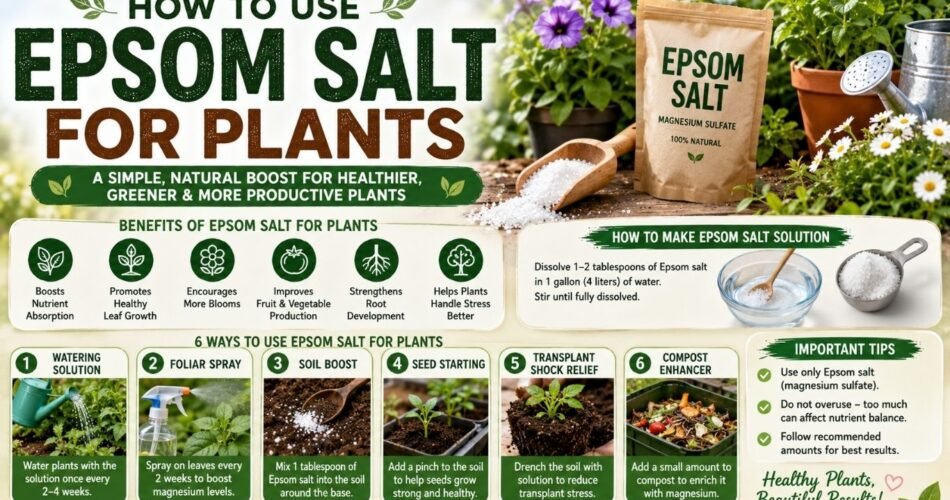
If you’ve spent any time in gardening forums or scrolled through plant care tips online, you’ve probably seen Epsom salt recommended as some kind of magical cure-all. Sprinkle it on your tomatoes! Spray it on your roses! Put it in every watering can!
The truth? It’s a bit more complicated than that — and more interesting.
Epsom salt can be genuinely helpful in the right situations. But it’s also one of the most overhyped and misused products in home gardening. Used incorrectly or unnecessarily, it can actually cause more harm than good.
In this guide, I’m going to walk you through everything you need to know about how to use Epsom salt for plants — not just the enthusiastic “yes, use it everywhere” version you’ll find on half the internet, but the full, honest picture. We’ll cover what it actually does, when it helps, when it doesn’t, what the science says, and how to apply it correctly if your plants truly need it.
Let’s dig in.
What Is Epsom Salt?
Epsom salt is the common name for magnesium sulfate (chemical formula: MgSO₄·7H₂O). It’s a naturally occurring mineral compound named after the town of Epsom in Surrey, England, where it was first discovered in spring water back in the 1600s.
In its pure form, Epsom salt looks like coarse white crystals — similar to table salt but without any sodium. It dissolves easily in water, which makes it convenient to use as either a soil drench or a foliar spray.
In gardening, people use it as a source of two nutrients:
- Magnesium (Mg) — a central component of chlorophyll, the molecule that makes photosynthesis possible. It also helps plants absorb phosphorus and acts as a cofactor in enzyme activity.
- Sulfur (S) — essential for protein synthesis, enzyme function, and the production of certain amino acids. It also plays a role in root development and seed production.
Here’s what’s critical to understand from the start: Epsom salt is not a complete fertilizer. It provides only magnesium and sulfur. It contains no nitrogen, phosphorus, or potassium — the three main macronutrients plants need most. If you use Epsom salt thinking you’re feeding your plants broadly, you’re missing the mark.
How Epsom Salt Affects Plant Growth
To understand when Epsom salt is useful, you need to understand what magnesium and sulfur actually do in a plant’s life.
The Role of Magnesium
Magnesium is a macronutrient (sometimes called a secondary macronutrient), and it’s one of the most important minerals in plant biology. Here’s why:
- It sits at the center of every chlorophyll molecule. Without enough magnesium, plants can’t produce adequate chlorophyll, which means they can’t photosynthesize efficiently.
- It activates dozens of enzymes inside plant cells.
- It helps transport phosphorus and sugars from leaves to roots and fruits.
- It supports seed germination and early seedling development.
The Role of Sulfur
Sulfur is often overlooked in gardening conversations, but it plays meaningful roles:
- It’s required for the synthesis of amino acids like cysteine and methionine, which are the building blocks of proteins.
- It contributes to the production of vitamins and certain plant defense compounds.
- It supports root growth and helps with the uptake of other nutrients.
The Important Caveat
Both magnesium and sulfur are already present in most garden soils, often in adequate amounts. Most problems attributed to magnesium deficiency are actually caused by other factors — soil pH issues, overwatering, root damage, or a deficiency of an entirely different nutrient.
This is why soil testing is so important before reaching for the Epsom salt. Adding magnesium sulfate to soil that already has sufficient magnesium can disrupt nutrient balance, cause a buildup of salts, and potentially suppress the uptake of calcium and potassium.
Signs of Magnesium Deficiency in Plants
Before you consider using Epsom salt, it helps to know what a real magnesium deficiency looks like. The classic signs include:
Visual Symptoms
- Interveinal chlorosis — This is the most telling sign. The leaf tissue between the veins turns yellow while the veins themselves stay green. This typically appears on older, lower leaves first, because magnesium is a mobile nutrient that the plant will pull from older tissue to support new growth.
- Yellowing that starts at the edges of leaves and works its way inward.
- Leaves may eventually become pale green or almost white in severe cases.
- In some plants, the yellowing takes on a purplish or bronze tint.
What Makes It Tricky
Interveinal chlorosis can also be caused by iron deficiency, manganese deficiency, or even overwatering — and the treatments are very different. Iron deficiency, for example, tends to show up on young leaves first (the opposite of magnesium deficiency), while magnesium deficiency starts on older leaves.
This is exactly why guessing and self-diagnosing plant problems is risky. A simple soil test — available at most garden centers or through your local cooperative extension office for around $15–$30 — will tell you exactly what’s going on in your soil.
Quick Tip: If you’re seeing yellowing between the veins on your older lower leaves while new growth looks healthy, that’s a reasonable indicator of magnesium deficiency. But confirm it with a soil test before treating.
Plants That May Benefit from Epsom Salt
Not all plants have the same magnesium requirements. Some are known to be heavy magnesium feeders, and these are the plants where Epsom salt has the most credible track record of making a visible difference — particularly when grown in depleted or sandy soils.
Plants with Higher Magnesium Needs
| Plant | Why It May Benefit |
|---|---|
| Tomatoes | Heavy feeders; magnesium depletion is common, especially in containers |
| Peppers | Similar to tomatoes; often show deficiency mid-season |
| Roses | Known to be sensitive to magnesium deficiency; can improve leaf color and bloom |
| Potatoes | Root crops that pull heavily on soil nutrients across a long growing season |
| Citrus trees | Particularly in sandy or acidic soils where leaching is common |
| Blueberries | Prefer acidic soil; magnesium can be scarce in low-pH environments |
| Brassicas (cabbage, broccoli) | Occasionally benefit, especially in heavy-production scenarios |
| Houseplants in pots | Nutrient depletion occurs faster in container soil |
It’s worth noting that even for tomatoes — probably the most commonly cited example — research from Washington State University Extension found that Epsom salt only improved yield when a true magnesium deficiency was present. In soils with adequate magnesium, it made no measurable difference.
If you’re growing tomatoes and want to maximize your results, pairing proper nutrition with the right variety matters enormously. Check out this guide to 10 High-Yield Tomato Varieties for Home Gardens to make sure you’re starting with the right genetics.
Plants That Usually Don’t Need Epsom Salt
Just as important as knowing what might benefit is knowing what probably won’t — and what might actually be harmed.
| Plant Category | Why Epsom Salt Is Rarely Needed |
|---|---|
| Leafy greens (lettuce, spinach, kale) | Typically grown in well-amended soil; quick growth cycle doesn’t deplete magnesium |
| Beans and legumes | Fix their own nitrogen; rarely show magnesium deficiency |
| Root vegetables (carrots, beets) | Usually do fine in adequately amended soil |
| Corn | Rarely magnesium-deficient in typical garden soil |
| Herbs (basil, parsley, mint) | Light feeders; extra magnesium can interfere with calcium uptake |
| Succulents and cacti | Highly sensitive to salt buildup; Epsom salt can cause root damage |
| Established trees and shrubs | Generally access nutrients from a wide soil volume |
| Lawns | Rarely magnesium-deficient; over-application can contribute to soil salt buildup |
If you’re growing lettuce in containers, for example, you’re better off focusing on proper soil mix, consistent watering, and a balanced fertilizer. I’ve written about the full approach in How I Grow Fresh Lettuce All Year Round in Containers — and Epsom salt doesn’t feature prominently in that routine, because it simply isn’t necessary.
How to Use Epsom Salt in Garden Beds
If you’ve confirmed (ideally through a soil test) that your plants have a genuine magnesium deficiency, here’s how to apply Epsom salt effectively in the ground.
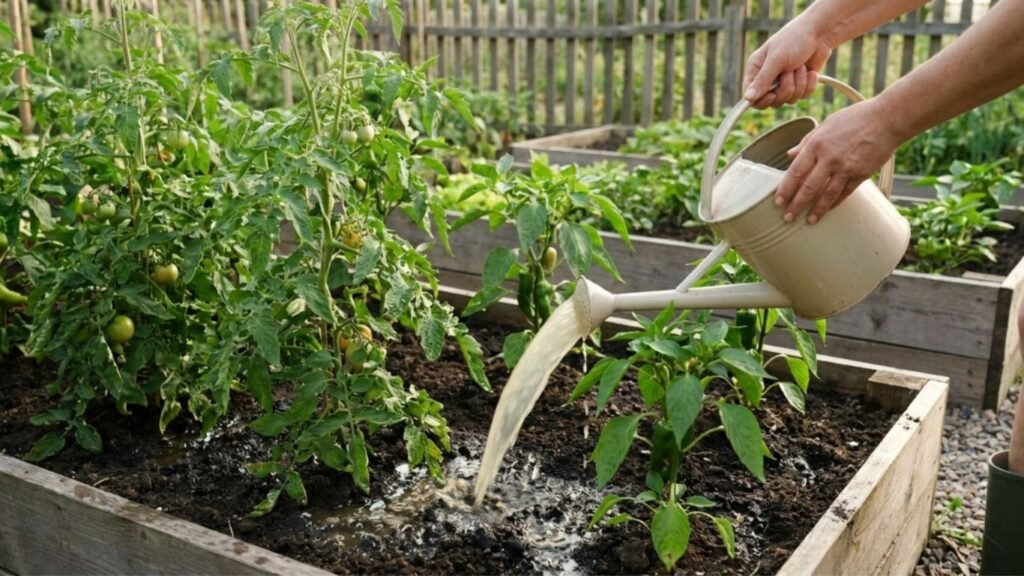
Soil Drench Method (Watering In)
This is the most effective way to deliver magnesium to plant roots.
Steps:
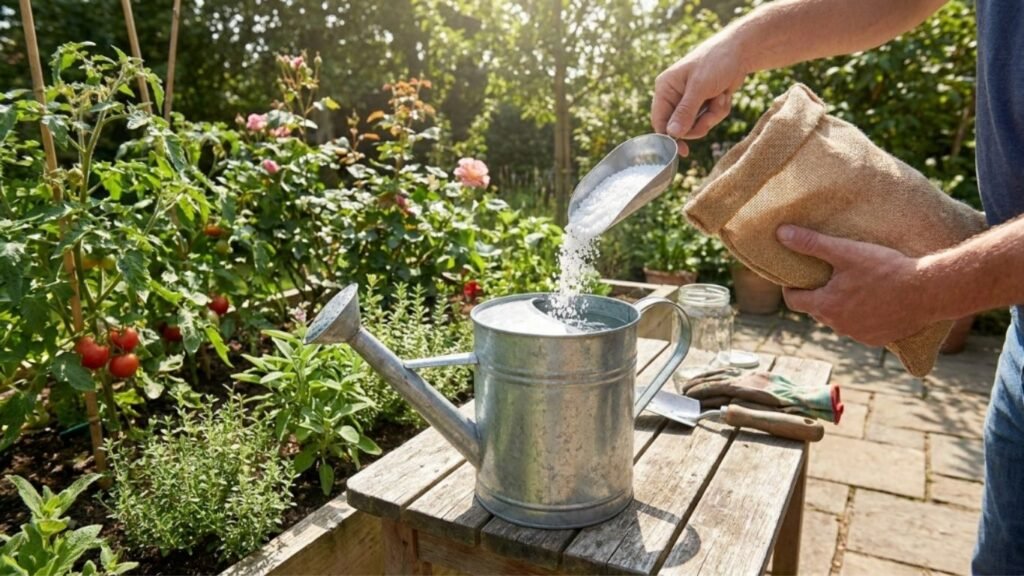
- Dissolve Epsom salt in warm water before applying — this ensures even distribution.
- Use the correct dilution rate (see the quick reference chart below).
- Apply directly around the base of the plant, avoiding the crown and stem.
- Water in thoroughly after application.
- Don’t apply more frequently than the recommended schedule.
Recommended dilution for garden beds: 1 tablespoon of Epsom salt per 1 gallon of water.
Apply once every 4–6 weeks during the active growing season. Do not apply in late fall or winter when plants are dormant.
Working Dry Epsom Salt Into Soil
Some gardeners work dry Epsom salt directly into the soil at planting time:
- Use approximately 1 tablespoon per foot of plant height worked into the surrounding soil.
- Or use 1–2 tablespoons per square foot when preparing a new bed (only if soil testing indicates magnesium is needed).
- Water thoroughly after application.
This is better suited for pre-season soil preparation than for correcting active deficiencies quickly.
How to Use Epsom Salt in Containers
Container plants are actually more likely to develop magnesium deficiency than in-ground plants. Here’s why: nutrients leach out of pots every time you water, and the finite soil volume doesn’t replenish itself naturally the way garden soil does.
Diluted Drench for Containers
- Mix 1 teaspoon of Epsom salt per 1 gallon of water (use a slightly lower concentration than garden beds to avoid salt buildup).
- Water your plant with this solution once every 4–6 weeks during the growing season.
- Make sure your pot has adequate drainage — salt buildup is a real problem in containers without good drainage.
- Flush the soil with plain water occasionally between treatments to prevent mineral accumulation.
Important: If you’re seeing white crusty deposits on the surface of your container soil or on the outside of terracotta pots, that’s a sign of salt buildup. Flush the pot thoroughly before continuing any Epsom salt treatments.
Soil Drench vs. Foliar Spray: What’s the Difference?
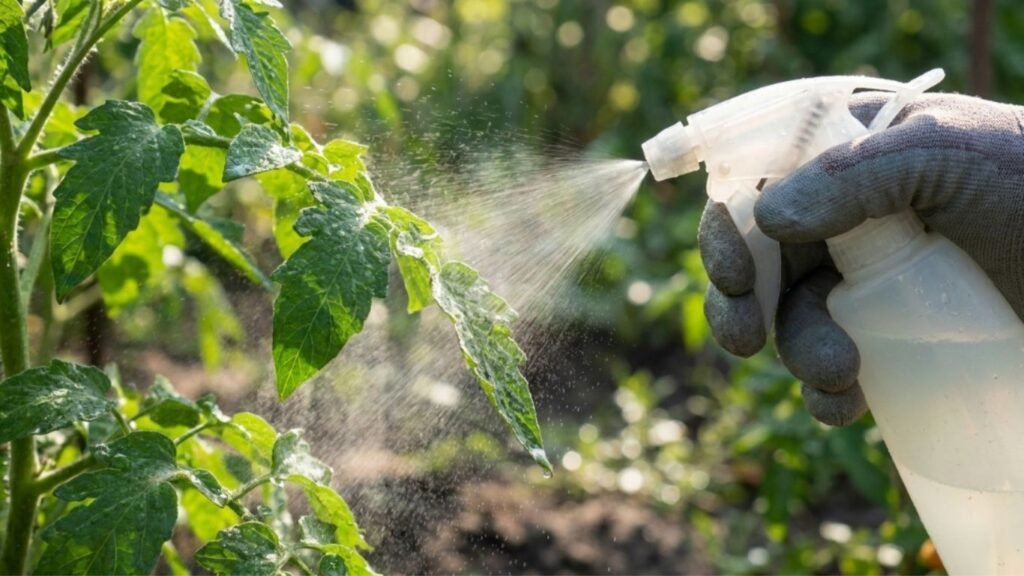
Both methods can deliver magnesium to your plants, but they work differently and are appropriate in different situations.
| Feature | Soil Drench | Foliar Spray |
|---|---|---|
| How it works | Magnesium absorbed through roots | Magnesium absorbed directly through leaf surfaces |
| Speed of results | Slower (days to weeks) | Faster (24–72 hours) |
| Best for | Long-term deficiency correction | Quick response to visible deficiency symptoms |
| Risk of overdose | Lower — soil buffers the application | Higher — concentration errors can burn leaves |
| Persistence | More lasting effect | Temporary; needs repeated application |
| Best time to apply | Morning or evening | Early morning or evening (never in direct sun) |
| Suitable dilution | 1 tbsp per gallon of water | 1 tsp per gallon of water |
| Frequency | Every 4–6 weeks | Every 2–4 weeks during active deficiency |
| Risk of soil salt buildup | Moderate — possible with overuse | Low — not going into soil |
When to Choose Foliar Spray
Foliar spraying is best used as a quick fix when you need to address visible deficiency symptoms fast. Because plant leaves can absorb nutrients directly, you’ll often see improvement within a few days.
How to do a foliar spray:
- Mix 1 teaspoon of Epsom salt per 1 gallon of water.
- Add a tiny drop of dish soap (optional) — this helps the solution stick to leaves.
- Fill a clean spray bottle and apply in the early morning or late evening.
- Never spray in direct sunlight — the droplets can magnify sunlight and cause leaf scorch.
- Coat both the upper and lower surfaces of leaves.
- Don’t apply before rain, or you’ll wash it away before it can be absorbed.
Common Mistakes to Avoid
Even gardeners with the best intentions can cause problems with Epsom salt if they’re not careful. Here are the most common errors I see:
1. Using It Without a Soil Test
This is the biggest one. Many gardeners reach for Epsom salt the moment they see any yellowing — but yellowing has many causes. Applying magnesium to a plant that already has sufficient magnesium can actually make things worse by competing with calcium and potassium uptake.
2. Applying Too Frequently
More is not more with Epsom salt. Applying it every week or every watering is excessive. Stick to the recommended frequency of every 4–6 weeks.
3. Applying to Dry Soil
Always water your plants before applying Epsom salt, or apply it to already-moist soil. Applying to dry soil can cause root irritation.
4. Spraying in Direct Sunlight
If you’re doing a foliar spray, do it in the morning or evening. Spraying in midday sun can cause water droplets to act as tiny magnifying glasses and burn leaf tissue.
5. Using It as a Replacement for Balanced Fertilizer
Epsom salt only provides magnesium and sulfur. It does nothing for nitrogen, phosphorus, or potassium — the nutrients plants need most. Relying on it instead of a complete fertilizer is a mistake.
6. Continuing to Use It When Plants Don’t Respond
If you’ve applied Epsom salt two or three times and you’re not seeing improvement, stop. The problem likely isn’t magnesium deficiency, and continuing to add it won’t help. Get a soil test.
7. Over-applying to Containers
Salt buildup in containers is a real problem. Don’t apply more than once every 4–6 weeks, and flush pots with plain water periodically.
Scientific Research and Expert Recommendations
Let’s talk honestly about what the science actually says.
What Research Supports
- A study published in the Journal of Plant Nutrition confirmed that magnesium sulfate application improved chlorophyll content and yield in magnesium-deficient crops.
- Horticulture researchers have noted genuine benefits in sandy, acidic, or heavily leached soils where magnesium naturally depletes faster.
- Citrus growers in Florida and California, where sandy soil is common, have used magnesium sulfate to address documented deficiencies with measurable results.
What Research Does NOT Support
- Washington State University Extension published a notable review concluding that Epsom salt applications show “no consistent benefit in most home garden situations.”
- A study on tomatoes found no statistically significant yield improvement when Epsom salt was added to soils that were not deficient in magnesium.
- The National Gardening Association and many cooperative extension services caution against routine Epsom salt use without confirmed deficiency.
What Experts Say
The consensus among soil scientists and extension horticulturists is clear: test your soil first. The American Society of Agronomy and most university extension programs recommend against “insurance” applications of any nutrient supplement without evidence of deficiency.
Epsom Salt Myths vs. Facts
Let’s clear up some of the most persistent myths circulating in the gardening world.
Myth #1: “Epsom Salt Makes Plants Grow Bigger and Produce More Fruit”
Fact: Only if the plant was magnesium-deficient to begin with. In plants with adequate magnesium, adding more makes no difference and can disrupt nutrient balance.
Myth #2: “Epsom Salt Prevents Blossom End Rot in Tomatoes”
Fact: Blossom end rot is caused by calcium deficiency — not magnesium deficiency. In fact, because magnesium and calcium compete for the same uptake pathways, adding Epsom salt to a plant with blossom end rot can actually make the problem worse by blocking calcium absorption.
Myth #3: “Epsom Salt Is Safe to Use as Often as You Want”
Fact: Overuse leads to salt buildup in the soil, which can inhibit water uptake, damage roots, and create toxicity problems over time.
Myth #4: “Epsom Salt Deters Garden Pests”
Fact: There is no credible scientific evidence supporting this claim. If you’re looking for evidence-based garden hacks, you might find more traction exploring options like those covered in 6 Baking Soda Tricks Every Gardener Should Know.
Myth #5: “Any Yellow Leaves Mean Your Plant Needs Epsom Salt”
Fact: Yellowing has many causes — overwatering, underwatering, root rot, iron deficiency, pH imbalance, pests, disease, and more. Magnesium deficiency is just one possibility and not even the most common one.
When to Use a Balanced Fertilizer Instead
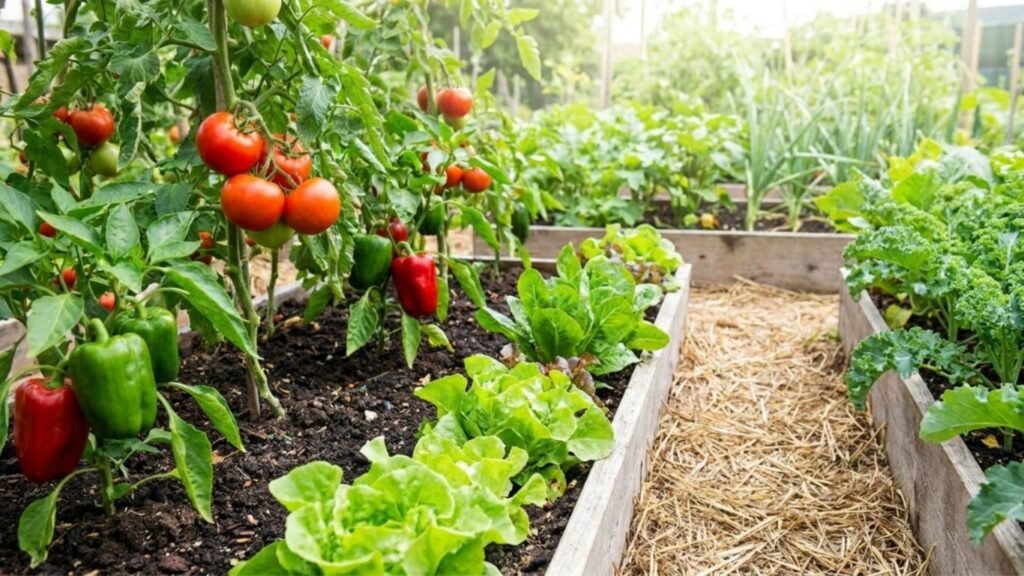
Epsom salt is a very specific tool. It addresses one (or at most two) nutrient gaps. In most gardening situations, what plants actually need is a balanced fertilizer that provides a range of nutrients.
Signs You Need a Balanced Fertilizer, Not Epsom Salt
- Stunted overall growth (suggests nitrogen or phosphorus deficiency)
- Purple-tinged leaves (often phosphorus deficiency)
- Poor flowering or fruiting (could be phosphorus or potassium)
- General pale color across the whole plant (likely nitrogen)
- Slow root development in seedlings
A good quality granular balanced fertilizer (look for an NPK ratio like 10-10-10 or 5-5-5) addresses a wide spectrum of nutrient needs. For organic gardeners, compost, worm castings, fish emulsion, and kelp meal are excellent broad-spectrum options.
The bottom line: reach for Epsom salt specifically — and only — when you have evidence of magnesium or sulfur deficiency. For everything else, use a complete plant food.
Speaking of natural soil amendments, it’s worth noting that coffee grounds are another widely misunderstood gardening product. Like Epsom salt, they have real but limited uses. Before adding them to your garden routine, read Coffee Grounds for Your Garden: Good or Bad? for a balanced look at when they help and when they don’t.
Epsom Salt Myths vs. Facts — Quick Summary
| Claim | Verdict |
|---|---|
| Cures blossom end rot | ❌ False — caused by calcium deficiency, not magnesium |
| Prevents pests | ❌ No credible evidence |
| Good for all plants | ❌ Only helpful where deficiency exists |
| Safe to use as often as you want | ❌ Overuse causes salt buildup |
| Boosts tomato yield | ✅ Only in magnesium-deficient conditions |
| Improves chlorophyll production | ✅ Yes — when magnesium is lacking |
| Can be used without soil testing | ❌ Not recommended |
| Works faster as a foliar spray | ✅ Yes — leaves absorb it quickly |
FAQ: Common Questions About Epsom Salt for Plants
1. How often should I apply Epsom salt to my garden?
For most applications, once every 4–6 weeks during the active growing season is appropriate. Applying more frequently than this risks salt buildup in the soil, which can harm your plants over time.
2. Can Epsom salt burn plants?
Yes. If applied too frequently, in too high a concentration, or to dry soil, Epsom salt can cause chemical burn to roots. Foliar sprays applied in direct sunlight can also cause leaf scorch. Always follow recommended dilution rates and application timing.
3. Is Epsom salt the same as regular salt?
No. Regular table salt is sodium chloride (NaCl), which is toxic to most plants. Epsom salt is magnesium sulfate (MgSO₄), which contains no sodium. The two should never be confused or substituted.
4. Can I use Epsom salt on all my houseplants?
Not necessarily. Succulents, cacti, and other salt-sensitive plants can be harmed by it. For houseplants that might benefit — like potted peppers or citrus — use a low concentration (1 teaspoon per gallon) and apply no more than once every 4–6 weeks.
5. Does Epsom salt raise or lower soil pH?
Epsom salt has a neutral effect on soil pH — it neither raises nor lowers it significantly. If your soil pH is the problem (either too acidic or too alkaline), Epsom salt won’t fix it. Use lime to raise pH or sulfur to lower it, based on soil test results.
6. Can I mix Epsom salt with my regular fertilizer?
Generally, yes — but check that your fertilizer doesn’t already contain magnesium. Adding Epsom salt to a fertilizer that already has adequate magnesium is redundant and potentially harmful. Always read the label of any fertilizer you use.
7. How do I know if my plants have a magnesium deficiency?
The clearest sign is interveinal chlorosis on older leaves — yellowing between the veins while the veins stay green, appearing first on lower, older leaves. However, visual symptoms alone aren’t definitive. A soil test is the most reliable way to confirm magnesium deficiency.
Key Takeaways
Before you head to the garden, here’s a quick summary of everything we’ve covered:
- ✅ Epsom salt is magnesium sulfate — it provides magnesium and sulfur only.
- ✅ It’s not a universal fertilizer. It helps specifically when magnesium or sulfur is deficient.
- ✅ Soil testing is the best first step. Don’t guess — test.
- ✅ Signs of magnesium deficiency include interveinal chlorosis on older leaves.
- ✅ Plants that may benefit include tomatoes, peppers, roses, citrus, and potatoes.
- ✅ Soil drench works best for long-term correction; foliar spray gives faster results.
- ✅ Standard dilution rates: 1 tbsp/gallon for soil drench; 1 tsp/gallon for foliar spray.
- ✅ Apply every 4–6 weeks during the growing season — not more often.
- ❌ Epsom salt does not fix blossom end rot — that’s a calcium issue.
- ❌ Overuse causes salt buildup and can disrupt nutrient balance.
- ❌ It doesn’t repel pests — that’s a myth with no scientific backing.
Conclusion
Epsom salt is a genuinely useful gardening tool — but only when used appropriately. It’s not the miracle plant tonic that gets passed around social media, and it’s not something you should be adding to every watering can as a routine habit.
When your soil is truly low in magnesium, or when a heavy-feeding plant like a tomato or pepper shows the classic signs of deficiency, Epsom salt can make a real, visible difference. But in most typical garden soils, it’s simply not necessary — and overusing it can cause the very problems you’re trying to prevent.
The most important habit you can build as a gardener is to observe carefully, test before treating, and address the actual cause rather than reaching for whatever remedy you last read about online.
Get a soil test. Look at your plants closely. Match your solution to your actual problem. That’s the approach that gets real results — and it’s what separates gardeners who struggle year after year from those who seem to effortlessly grow thriving, productive gardens.
Now go check on those tomatoes. 🍅